Lindale History


The Blackberry Capital of the World
Founded in 1871
The area of Smith County where Lindale sits was inhabited long before the town was founded in 1871. In the early 19th century, the Caddo Indians were the area’s primary inhabitants. Their artifacts can still be found along the streams in the area. In addition, Cherokee Indians were present until they were forced out when the Republic of Texas was founded in 1836. After the Civil War, Richard B. Hubbard, a former officer in the Confederate Army and owner of a large plantation on what is now a gated community called Hideaway Lake, began searching for a more convenient way to ship the produce grown on his land.
Hubbard convinced railroad officials to lay trach between nearby Tyler and Mineola. Hubbard’s brother-in-law, Elijah Lindsey, anticipating growth around the new railroad, opened the fledgling community’s first general store in 1871, and Lindale had its start. Lindsey was elected the town’s first mayor a year later.
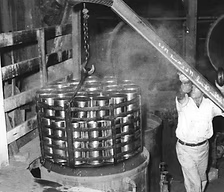
Several stories abound locally about how Lindale got its name, but the most common is that Lindsey’s name was combined with the suffix, “dale” to form “Lindseydale.” The name was shortened to Lindale in 1874 when the first post office opened in town. A year later, the International Great Northern Railroad extended it line through Lindle, and the town’s fledgling caning and fruit packing industries took off. By the late 1880s, about 300 people lived in the town, which was gaining fame for its fruit and berry canning industry.
By 1900, the city had its own newspaper, two cotton gins, several shops, churches, a telephone exchange, a doctor and lawyer, as well as the ubiquitous canning factory. In 1905, the town was incorporated, it spanned about a square mile in total. Produce continued to be the city’s main source of income, and by 1950 the town had gained a reputation for being the “blackberry capital of the world,” with tons of berries being canned and shipped each year.
The 1949 comedy film release, Strike it Rich, starring Rod Cameron and Bonita Granville, was filmed in Lindale, Tyler and the Kilgore area. An exhibit on the picture is found at The Old Mill Pond Museum.